
Jef Staut | Wag the dog | 26.09.2026 - 15.11.2026
D : Now I’ve got another. Why does a dog waggle his tail?
F : Upon my word, I never inquired.
D : Because the tail can’t waggle the dog. Ha! Ha!
— Tom Taylor, Our American Cousin (1869)
The expression the tail wagging the dog has since come to describe a situation in which something apparently insignificant begins to control the thing that should, logically, be controlling it. A minor element driving the main operation.
Try picturing the above: a dog’s tail remaining perfectly still, while the rest of the body wags from side to side with ecstatic excitement. A simple reversal, almost impossible to visualise without an involuntary smile or sense of wonder. Nothing has changed except the relationship between the parts. Somehow, that is enough to make the familiar appear strange.
In Jef Staut’s first solo exhibition, something similar seems to happen. Patterns, shapes, and shadows are repeatedly brought into relation, but their roles are never entirely fixed. What unites this selection of twenty-something paintings is a subtle disturbance: nothing is completely strange, yet nothing behaves quite as expected. A roof remains a roof, a shadow remains a shadow, a shape remains a shape. And yet they begin to feel slightly out of place. The humour lies precisely in the fact that everything looks almost reasonable.
Staut’s background in animation provides a subtle framework through which his visual language can be read. Before painting, he was trained to think through sequences, repetition, and the small differences between one frame and the next. Principles such as squash and stretch*, timing and spacing**, and inbetweening*** suggest how movement can be created through subtle changes in shape, position, and interval. In Staut’s paintings, these principles remain without movement itself: forms return, shift, stretch, disappear, and reappear. Repetition becomes a way of learning shape. The process is one of both reduction and accumulation. Drawing things again, stripping them down, and placing them into new relationships. His images emerge through a constant rearranging of visual furniture: moving things aside, taking things away, putting them back somewhere else, and seeing what becomes possible in the resulting space. There is something of a slapstick logic to this: forms seem to stumble into one another, fall out of place, or return at precisely the wrong moment.
In the move from sketchbook to canvas, cardboard functioned as an inbetween. It allowed the drawings to leave the proportions of the page and begin to occupy space differently. The canvas followed, carrying some of the behaviour of the sketchbook with it: smudges, scratched-out alterations, overlaps and the accidental relationships that occur when two pages meet. Layers of paint behave almost like a stack of papers, complete with their own little see-throughs and bleed-throughs.
Throughout Wag the Dog, this logic plays out against a recurring tension between order and interruption. Roof tiles establish a rigid rhythm, while Magritte blue skies open onto a more optimistic kind of possibility. Against this order, Staut’s recurring vocabulary begins to take shape: shadows, drops and splashes, curves, painter’s-palette forms, ladders, and other shapes that hover between object and sign. Many of these forms first appear in Staut’s sketchbooks, where they are repeatedly drawn, altered, and recombined. From there, they migrate into the paintings, carrying with them the sense of a vocabulary still being formed. Some are solid, others seem like traces of something that was once there. Like a plastic peg puzzle, a shape can suggest both an object and its imprint, never quite settling into either.
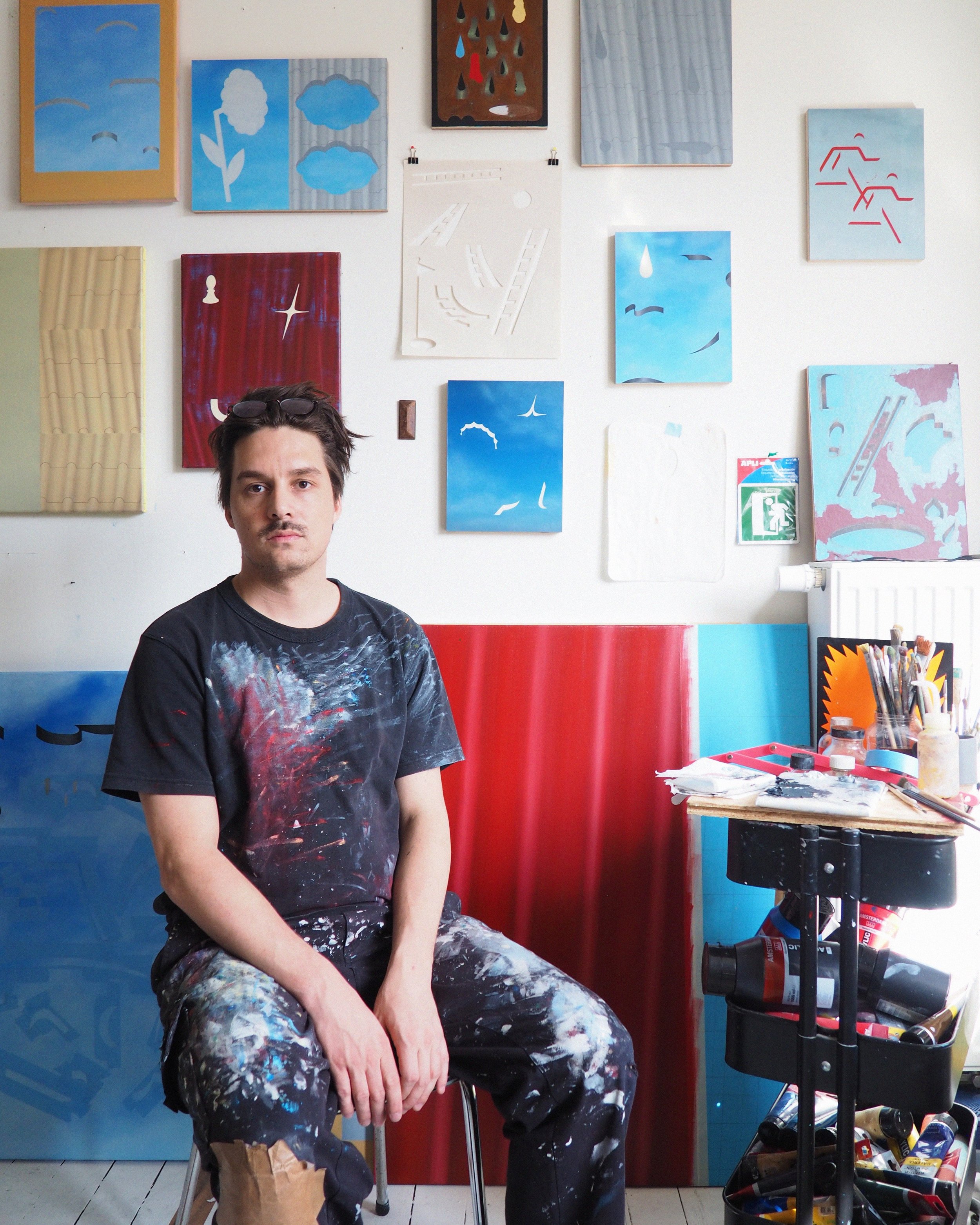
Jef Staut in his studio in Brussel
Gradually, this vocabulary begins to feel almost alphabetic. Shapes start to resemble letters, signs, or symbols; their combinations suggest an invented script, a language that looks as though it ought to mean something while refusing to settle into a fixed system. It is a kind of poetic make-believe: just convincing enough to make the eye search for a meaning. The question of what these forms depict is therefore almost beside the point. Staut is less interested in explaining than in allowing an image to acquire its own set of rules.
Like animation, the paintings keep their meaning in motion. Staut’s paintings can then be understood as animation that has been made static, or, vice versa, as painting that still behaves as though it could move: when the logic of the image becomes strong enough, the tail begins to wag the dog.
*Squash and stretch is one of the most important principles of animation, defined as changing an object's shape to show weight, volume, and flexibility.
**Timing and spacing are the core foundations of motion design. Timing defines when things happen by counting total frames or duration, while spacing decides where those drawings or positions fall in between to show weight, speed, and physics.
***Inbetweening is a process in animation that involves creating intermediate frames, called inbetweens, between two keyframes.
Biography Jef Staut
Jef Staut (°1994, lives and works in Brussels) obtained his Master’s degree in Animation Film at KASK in Ghent in 2016. His background in hand-drawn animation continues to inform his approach to painting: drawing, repetition, sequencing and variation remain central to his way of working. His sketchbook functions as an important starting point: rather than animating a frame through time, he seems to animate forms across its pages.
Following a duo residency with his fiancé and fellow artist Ellen Meers at the Frans Masereel Centrum in 2023, Staut began pushing his sketchbook beyond the page: first by translating this process from sketchbook to cardboard and, eventually, canvas. His visual vocabulary draws on the bold colours and simplified shapes of toys and boardgames: plastic puzzles, Snakes and Ladders and cut-out drawing stencils that are repurposed, transformed, and find their way to his studio.
Selected exhibitions
2026
23.05 - 28.06 : ‘Works on Paper’, Barbé Gallery, Ghent (BE)
Group show curated by Oliver Barbé
03-26.04 : ‘Poetry in Motion’, CAS, Ostend (BE)
Group show curated by Nadine Prieels
2025
20.11 : ‘Kabinet #12’, Kabinet, Ghent (BE)
Group show with Edith De Doncker, Brecht Drieghe & Bas Van Den Hout
18-26.10 : ‘Playgrounds’, Yugen Kombucha, Ghent (BE)
Group show curated by Sam Timmerman
17.05 - 19.06 : ‘Works on Paper’, Barbé Gallery, Ghent (BE)
Group show curated by Oliver Barbé
22.03 - 20.04 : ‘The Pencil Show’, CC Zwaneberg, Heist-op-den-berg (BE)
Group show curated by Roeland Tweelinckx
01-23.03 : ‘Playgrounds’, Studio Artoo, Antwerp (BE)
Group show curated by Sam Timmerman
20.02 : Opgenomen in collectie, Kunst in Huis, Brussels (BE)
2023
12.12.23 - 12.02.24
Vitrineproject, Kunst in Huis, Antwerp (BE)
Duo w/ Ellen Meers